This post is a short version of my talk during InSpark Inspiration Day, an event organized by my employer. By request of others, a written version.
If you know me a little, you know that I am a big fan of the sloth. Not because they are lazy. It is because they are smart. They move slowly and with purpose to save energy. In my own busy life as a consultant, speaker and member of Dutch Women in Tech, I try to do the same. I do exactly what is needed without letting the chaos of the jungle drive me crazy.
However, in our modern ‘office jungle’ that is easier said than done. We live in a world designed for speed, constant connectivity, and multitasking. I see this struggle every day in my work. It is tiring for almost everyone. But for the 15 to 20 percent of people who are neurodivergent (think of autism, ADHD, dyslexia), the standard work environment is often not a place of productivity. It is a place of survival. This also means that I prefer my weekends to be completely empty, that is when I recharge.
Today I want to share why that is, and how I believe Artificial Intelligence (AI) can help balance the scales.
Forget the line, think of the wheel
Let’s look at autism in particular. This is the area I am most familiar with, simply because it is my reality. I received my own diagnosis when I was 15 years old. Back then, the label given to me was PDD-NOS. At the time, it was often brushed away as being just “a little bit autistic” or “no big deal.”
Luckily, the medical world has moved on. It is all categorized under the general name of autism now. I received fresh psychoeducation a few years ago, and the quality was worlds apart from what I heard all those years ago. It helped me understand that my brain isn’t “broken” or a “lite version” of a diagnosis. It is just wired differently.
This evolution in thinking is crucial. When we talk about autism or neurodiversity, people often still think in a straight line. They think on one end you are “a little autistic” and on the other end “very autistic.” It does not work that way.
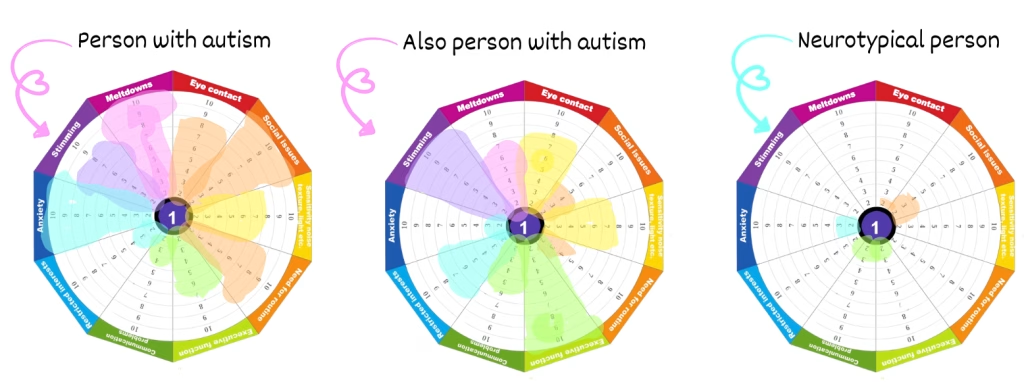
Recent insights, such as the autism spectrum wheel, show that neurodiversity looks much more like a pie chart or a mixing desk in a music studio. The wheel consists of different sections representing traits such as:
- Sensory processing (sound, light)
- Social communication
- Executive functions (planning, organizing)
- Motor skills
- Information processing
Someone might be very skilled in the ‘Social communication’ section but might get overwhelmed very quickly in the ‘Sensory processing’ section. Someone else might have a fantastic memory for details but gets stuck when planning a day. Every neurodivergent person has a unique mix of these settings. There is no single type of ‘autism.’
The Spiky Cognitive Profile: Flatlands versus Mountains
This brings us to the concept of the spiky cognitive profile.
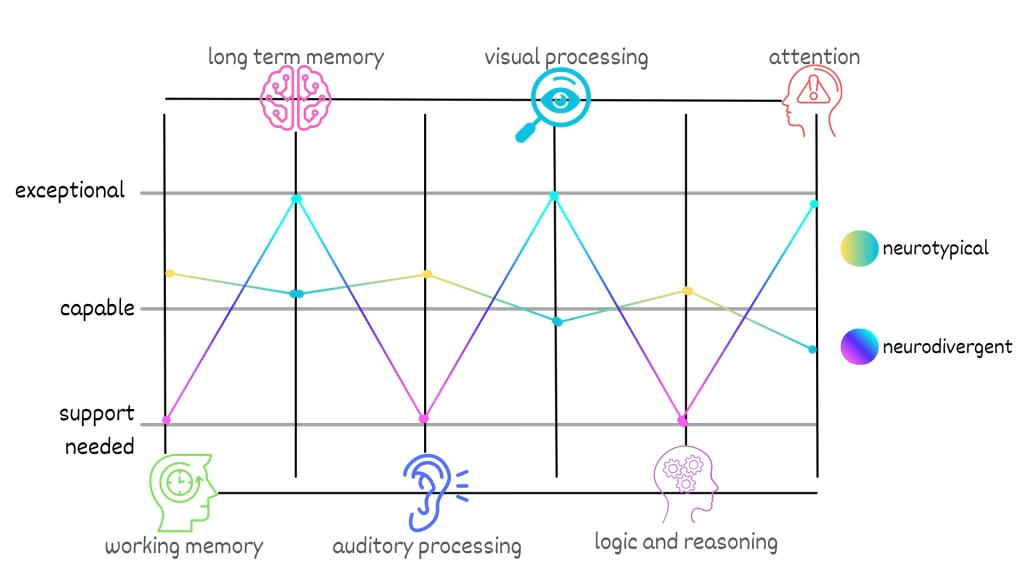
Neurotypical people (people without neurodivergence) often have a fairly flat skills profile. Think of it like the Dutch flatlands where I live. They might be slightly better at language than math, but generally, they score ‘average to good’ on all fronts. They can plan reasonably well, communicate reasonably well, and handle distractions reasonably well.
Neurodivergent people often have a landscape that looks like a mountain range. They have enormous peaks (strengths) and deep valleys (difficulties).
- The Peak: This is the superpower. Someone can get into a hyperfocus and move mountains of work, see patterns no one else sees, or be incredibly creative.
- The Valley: These are the things that are unexpectedly difficult. Making a simple phone call, attending a meeting in a busy room, or understanding a vague email can feel impossible for someone with this profile.
The problem I see in the workplace is that we expect every employee to be a ‘flatland.’ We expect everyone to be able to do a bit of everything. When someone with a spiky cognitive profile gets stuck in a ‘valley’ (for example: trouble with administration), we often forget to look at that huge peak right next to it (for example: brilliant strategic insight).
AI as Your Digital Equalizer
As a Microsoft 365 specialist, I see AI not just as a way to work faster, but as a way to work smarter and kinder. It is about using the tools we have in Microsoft 365 to fill those valleys so your talent can shine on the peaks.
Here is how I use these tools in practice to support different needs:
1. Stopping the Information Flood
We all know that feeling of opening an inbox and wanting to close it immediately. For someone who is neurodivergent, that information overload can cause a total shutdown and massive anxiety.
- My approach: I use Copilot to filter out the noise. Instead of reading every word of a long thread, I ask: “What are the action items for me?” It saves my cognitive energy for the work that actually matters. It is about protecting your focus.
2. The Confidence to Click ‘Send’
I have managed to accidentally offend people in the past. Totally unintentional. I struggle finding the right tone of voice. If, like me, you are naturally direct or struggle with social nuance, drafting an email can take twenty minutes of worrying.
- My approach: Use the technology as a safe space to test your words. You can write your honest, direct thoughts and simply ask Copilot: “Rewrite this to be professional and friendly.” It removes the anxiety. You can be yourself, and let the AI handle the polish.
3. Breaking Down the Mountain
The hardest part of any project is often just starting. For the A(u)DHD brain, a big project looks like an unclimbable mountain, so we procrastinate. Out side of work, it can take me weeks to actually start on a LEGO set I really wanted, because the thought of starting is too overwhelming.
- My approach: I use AI to turn that mountain into molehills. I ask Copilot to break a strategy down into a simple checklist. Suddenly, it is not a scary project anymore. It is just ten small steps. It turns “I can’t do this” into “I can do step one.”
The Future: Agents as Your Digital Buddy
This is the part that excites me the most. We are moving from chatbots (where you have to ask for help) to AI Agents that proactively help you. Think of them as a digital version of “body doubling”—having a buddy who keeps you on track.
Imagine a Focus Agent that notices you are deep in concentration and automatically blocks your notifications so you don’t get distracted. Or a Planning Agent that knows you need a break. It sees you have had two heavy meetings back-to-back and suggests: “Hey, shall I block 15 minutes for you to recharge?”
AI agents let us continue to work in a way that works for us. Whether that might be by visual reminders, audio reminders, or being able to use speech and have your input rewritten in the correct tone of voice for your audience… the possibilities are endless.
It is like having a personal assistant whose only job is to protect your energy and help you function at your best. We aren’t quite a this point yet, but technology is moving fast. Who knows, this might be reality in a few years.
Conclusion: A flexible layer of support
Technology is amazing, but it is not a replacement for understanding. However, I truly believe that AI will make the workplace more accessible and inclusive. It adds a flexible layer of support that everyone can use, not just those with a diagnosis.
When we combine this technological support with a real understanding of neurodiversity, we stop trying to flatten mountains into flatlands. Instead, we build bridges over the valleys. This ensures everyone can reach their peak in their own unique way.